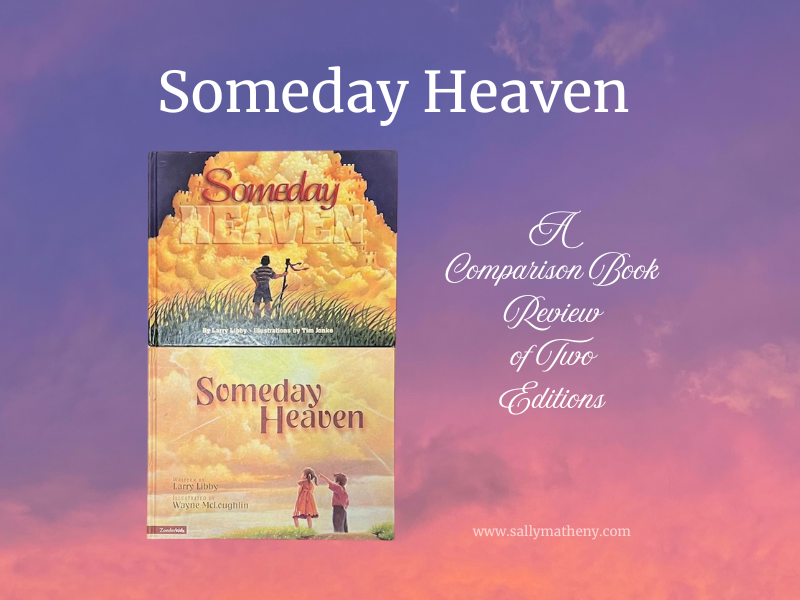
Someday Heaven: Comparison Book Review of Two Editions
Recently, I searched for children’s books about heaven to place in our church library. During my search, I noticed two editions of the Someday Heaven book by Larry Libby. There are distinct differences between the 1993 and the 2001 editions. Since both of these books can be found for sale, allow me to shed some light on the differences so you may select the edition that’s best for your family.
About the Author
Larry Libby was an author and editor who has written a number of books and has co-authored books with Joni Eareckson Tada and Ken Tada, including Joni and Ken: An Untold Love Story.
I could not find a website or social media outlets for Larry Libby so the only information I have is that he and his wife lived in Washington during the first printing of Someday Heaven and in Oregon during the second printing.
Also, in a Febuary. 10, 2006 article on Foursquare.org, I discovered that Libby was appointed to serve as senior editor of a developing book publishing division called Foursquare Media Literature Group. The article stated that Libby “is a gifted man with 30 years of editorial expertise with Multnomah Publishing and has edited for such noted authors as James Dobson, Chuck Swindoll and Thomas Kinkade, as well as for well-known Foursquare leaders Ron Mehl and Jack Hayford.”
Pastor, Jack Hayford said this about Larry Libby:
“Larry is a rare treasure in the art of printed conversational English,” notes Hayford. “Few senior editors demonstrate this grasp with such a touch of grace, clarity and Holy Spirit sensitivity. [He has received] several national and international awards in writing.”
The 1993 Edition Publisher and Illustrator
Gold ‘n’ Honey Books published the 1993 edition of Someday Heaven. They marketed it as a gift book for children of all ages.
Scriptures are taken from the International Children’s Bible; New Century Version; and the New International Version.
Illustrating a book about heaven has to be one of the most difficult challenges! It’s a so beautiful and perfect that it’s uncomprehendable. The scriptures do tell us about it but the human mind still can’t fully comprehend such a glorious place. The illustrator for the 1992 edition,Tim Jonke approached the task of illustrating heaven with muted colors and fuzzy features. I appreciate his effort in not illustrating presumptuous respresentations of heaven. However, I think children may find the illustrations depressing, maybe even a little bit scary. There is a lack of color and many of the figures appear ghost-like.
The 2001 Edition Publisher and Illustrator
Zonderkidz published the second edition and marketed it as a children’s picture book for ages 4 – 8. Scripture passages in this edition are from the New International Reader’s Version.
Wayne McLoughlin illustrates this book using bright colors. He focuses on things with which children have prior knowledge.
For example, in both editions the author answers the question: Will anyone meet me when I get to heaven? The text includes these statements:
. . . When you go to your grandparents’ house, isn’t it fun to see them
watching for you through the big window?
. . . Maybe the people who will smile the biggest welcome will the the ones who prayed for you and taught you about Jesus. How happy they will be to see that you gave your life to the Lord!
Tim Jonke (1993) uses whites and grays and focuses on illustrating misty-looking angels greeting a child into heaven.
Wayne McLoughlin (2001) illustrates this passage with a clear, colorful grandmother in the flesh peeking out of a window.
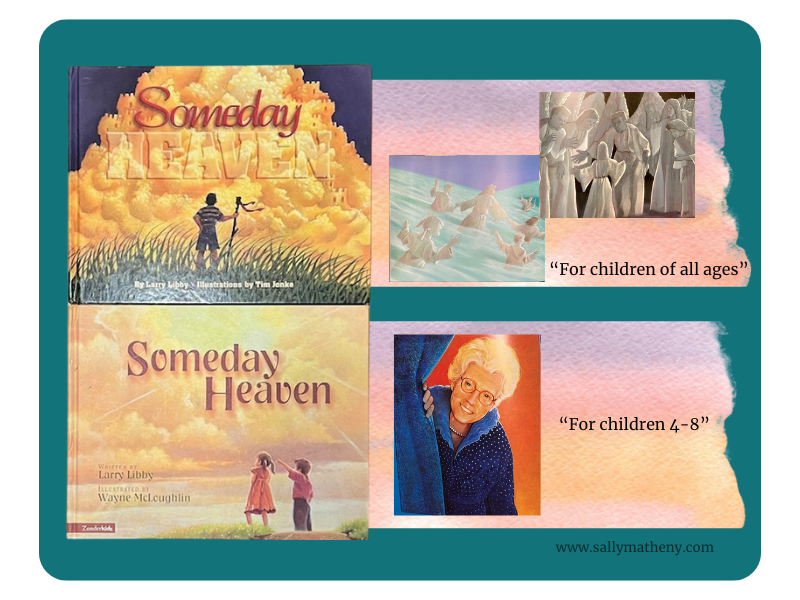
The illustrations vary greatly.
Content Similarities and Differences
Topics are addressed from a biblical viewpoint. The author makes clear what we do know about heaven based on God’s Word. He emphasizes that we do not know for sure what some aspects of heaven will be like. But there are several instances when he addresses a question with a maybe.
For example, he points out that the Bible doesn’t say anything about pets going to heaven. But that God is full of surprises so our pets may be there. The book’s message conveys that no matter what, God will take care of all our needs. Heaven is a place of peace and joy!
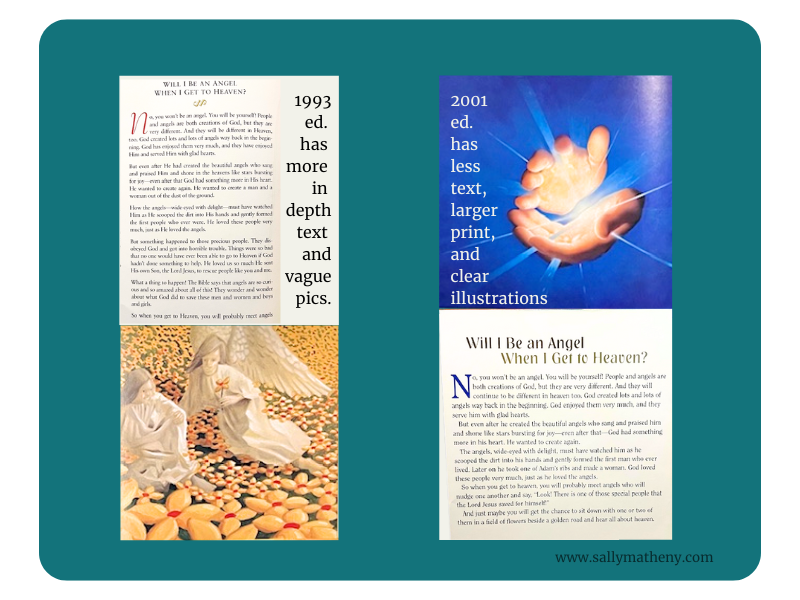
The 1993 edition addresses eight questions that are not in the newer edition. It also has lengthier explanations and includes more scriptures than the 2001 edition.
Questions Discussed in Both Editions
The 2001 edition has lenghier explanations and includes more scripture references but the following questions are discussed in both editions:.
Where is Heaven?
How Can I Get to Heaven?
Who Lives in Heaven?
How Long Does It Take to Get to Heaven?
Will My Pets Go to Heaven?
How Long Will I Be in Heaven?
Will My Grandpa Still Be Old in Heaven?
Will It Always be Light in Heaven?
Will Anyone Meet Me When I Get to Heaven?
Will I Need Money in Heaven?
Will I Ever Be Sad in Heaven?
Will There Be Other Children in Heaven?
Will I Be an Angel When I Get to Heaven?
How Can I Know for Sure I’m Going to Heaven?
Questions Addressed Only in the 1993 Edition
Perhaps due to the publisher trying to reduce the word count to make the book more age-appropriate, several questions were omitted from the 2001 edition.
What is the Closest I Can Be to Heaven?
What If I Get Tired of Being in Heaven?
If Heaven is So Good, Why are People Afraid to Die?
Will There Be Room in Heaven?
Who Are the Angels?
Do I Have to Die to See Heaven?
Will I Be Able to Fly in Heaven?
Why Does My Great-Grandma Want to Go to Heaven Even More Than Staying Here With Us?
Will Everyone Go to Heaven?
Overall Thoughts
I like the biblically-based content in both editions. The questions were addressed well and in such a way most young children will understand. We have to remember that children think in concrete terms. They don’t develop abstract thinking until around 10 – 12 years old. Heaven can be a challenging concept to grasp but it doesn’t mean we have to wait to introduce this amazing place until our kids are older.
The text in the 1993 edition is more in-depth, but it may be too lengthy for younger children. I’d use this edition for older kids age 8 – 12. Also, it may come in handy as a quick reference book for parents when talking to children about heaven. The book will help parents know (based on scripture) why we don’t tell children a loved one is an angel in heaven!
Children 4 – 8 years old will enjoy the colorful illustrations in the 2001 edition more than those in the older edition. The font is larger in the newer edition. Plus, the text is composed of excerpts from the first edition, therefore it’s not as lengthy and will hold children’s attention better. Also, these elements may encourage more independent reading.
Children will find the wording in both books comforting and encouraging. They are good for family-time reading and discussion. Both are biblically accurate about the Way we can enter into heaven and Who we will glorify and celebrate in heaven.
If I had to choose between the 1993 and the 2001 editions to read to my young grandchildren, I’d select the newest edition because of the illustrations.
However, if a third edition is ever published, I’d love to see people of various skin colors represented in the illustrations.
Other Books About Heaven I Recommend
The Awesome, Super, Fantastic Forever Party by Joni Earekson Tada. I hope to review this children’s book next year.
Also, I’ve reviewed Charles Stanley’s Gift of Heaven, a wonderful book for adults.
Do you know other children’s books written with a biblical worldview about heaven
you can recommend?

Motivated by the power of story, history, and His Story, Sally Matheny’s passion is telling the next generation wondrous things.
Her nonfiction writing appears in worldwide, national, and regional publications including Appleseeds, Clubhouse Jr., Homeschooling Today, and The Old Schoolhouse.
She and her husband live in the foothills of the Blue Ridge Mountains and are blessed with three children, two sons-in-law, and armfuls of grandbabies. Connect with Sally on several social media sites, but her favorite hangouts are at SallyMatheny.com and Pinterest.


You May Also Like

The Gospel Story for Kids: Book Review
God is Always Good {Book Review}